Content, Social & AI · 3 min read
Content Marketing vs Content Production
Production asks how we make it; marketing asks why it should exist and where it belongs. Growth needs both, connected by performance feedback.
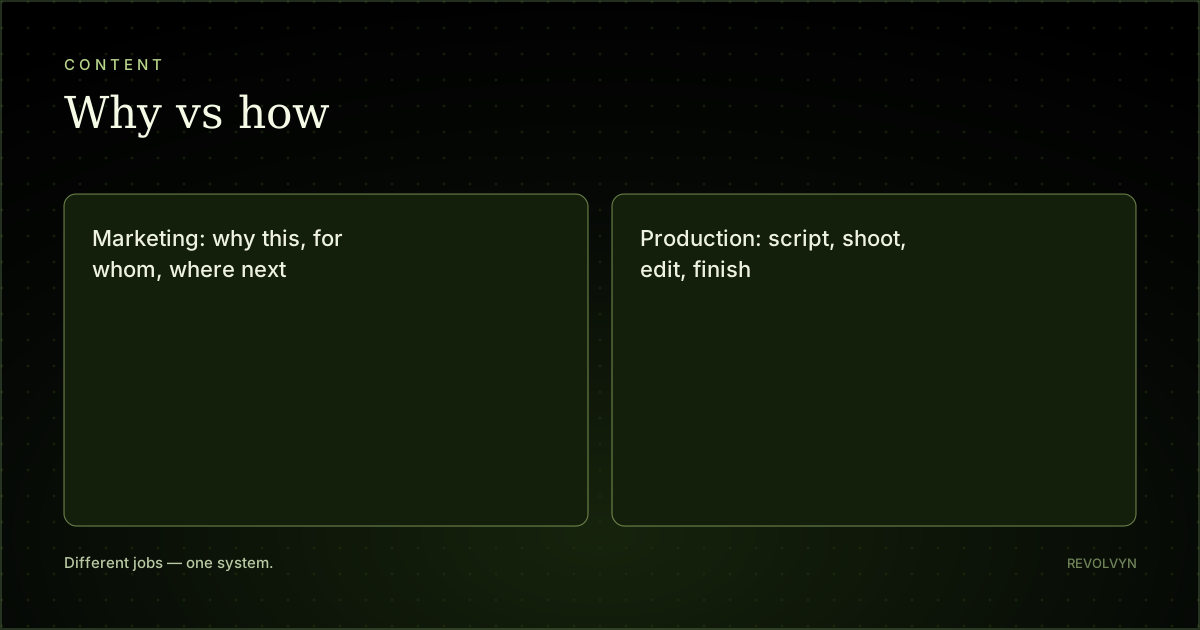
Content marketing and content production are closely connected, but they are not the same job.
Production creates the asset.
Marketing decides why that asset should exist, who it is for and where it belongs in the wider customer journey.
A brand can have excellent production and still have weak content marketing.
Production answers “How do we make it?”
Content production covers the practical work:
- scripting
- shooting
- editing
- motion graphics
- captions
- visual direction
- post-production
REVOLVYN's content production service covers those areas and states a production volume of 35–40+ videos per month.
Content marketing answers “Why this content?”
Marketing starts with the audience.
What question do they have?
What problem are they trying to solve?
What does the brand need them to understand?
What should happen after they consume the content?
Those questions shape the content strategy.
Why the distinction matters
Imagine a brand produces 30 videos in a month.
If e
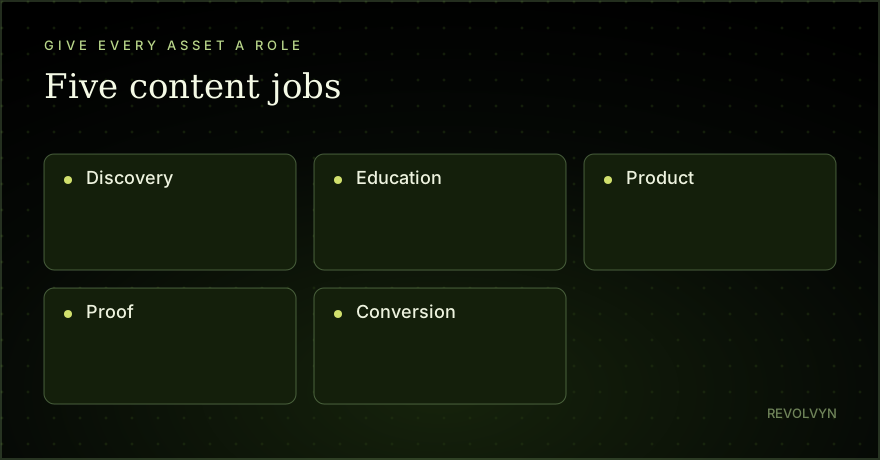
A strategy can create different roles:
Discovery content gets the right people interested.
Education content makes the category easier to understand.
Product content demonstrates the offer.
Proof content reduces uncertainty.
Conversion content gives the audience a reason to act.
The mix depends on the business.
Content should learn from performance
A content calendar should not be frozen forever.
If a certain type of opening repeatedly earns attention, create more variations.
If a topic consistently gets ignored, investigate why.
If a product question keeps appearing in comments or sales conversations, turn that question into content.
That creates a feedback loop between marketing and production.
Why volume alone is not enough
Publishing frequently can help a brand build a library.
But more content is not automatically better.
Google's spam policies specifically warn against creating large volumes of low-value pages primarily to manipulate search rankings. The underlying principle applies well to content strategy generally: publishing should add value rather than simply increase page count.
The goal is not “30 pieces.”
The goal is “30 useful opportunities to communicate something.”
The strongest content teams connect strategy and production
When the person planning content understands how it will be used, production becomes more focused.
When the production team sees performance feedback, the next creative brief becomes smarter.
That is the real connection between content marketing and content production.
Strategy decides what deserves to be made. Production makes it well. Performance tells you what to make next.
Editorial note — This article is written for educational purposes and uses examples and capabilities documented on REVOLVYN's public website. Specific campaign outcomes, pricing and client-specific performance should be verified for the relevant engagement rather than assumed from general marketing guidance.
Related articles
Talk to REVOLVYN about your growth plan.
Have a campaign in mind? Start with a free 15-minute consultation and we’ll reply within one business day.
Contact REVOLVYN