Content, Social & AI · 3 min read
Video Production for D2C Brands: What to Produce
Plan the shoot from the distribution plan: one production day should fill the ad library — ads, Reels, demos, site video and retargeting cuts.
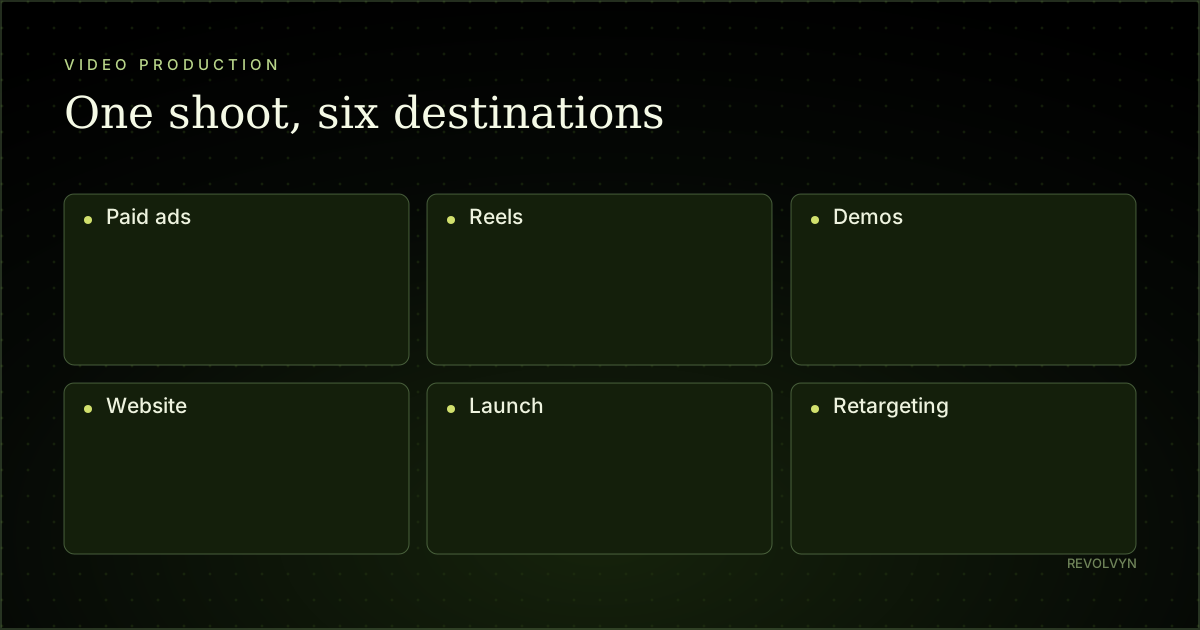
D2C brands rarely need one beautiful video and nothing else.
They usually need a collection of creative assets that can work across product pages, social platforms, launches and paid campaigns.
That changes how production should be planned.
Start with the distribution plan
Before a shoot, ask where the footage will be used.
Will it become:
- paid social ads?
- organic Reels?
- product demonstrations?
- website videos?
- creator collaborations?
- launch content?
- brand films?
A shoot becomes much more efficient when the production plan starts with the distribution plan.
REVOLVYN's content production service covers scripts, shoots, production, editing, motion graphics, colour grading and captions, with a stated production volume of 35–40+ videos per month.
One shoot can produce multiple creative directions
A product shoot should not be designed around one final edit.
Thin
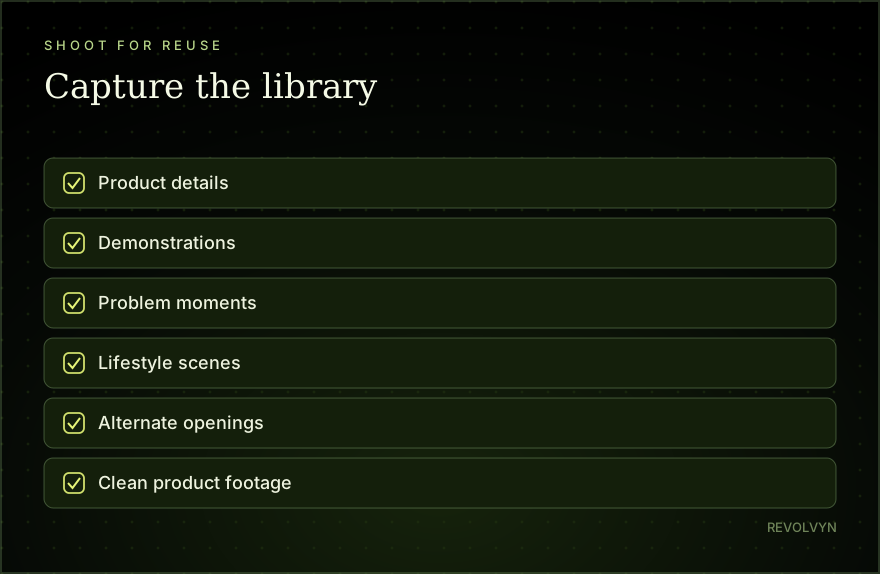
Capture:
- product details
- demonstrations
- close-ups
- problem/solution moments
- lifestyle scenes
- alternate openings
- different aspect-ratio needs
- clean product footage
That gives the editing team more options later.
Brand film and performance creative are different jobs
A cinematic brand film can communicate identity, mood and product world.
A performance creative may need to communicate the product benefit in seconds.
Neither is automatically better.
They solve different communication problems.
REVOLVYN works across cinematic content, performance creative and paid media, which allows production decisions to be connected to the campaign rather than made independently.
What should the brief contain?
A useful production brief should answer:
Who is this for?
What should they understand?
What should they feel?
What should they do next?
Where will the asset appear?
What claims or product details must be accurate?
That is enough to give the creative team a direction without writing every frame in advance.
Production quality is not only about the camera
A technically beautiful video can still be weak marketing.
The idea, script, opening, product demonstration, pacing and CTA all influence whether the viewer understands the message.
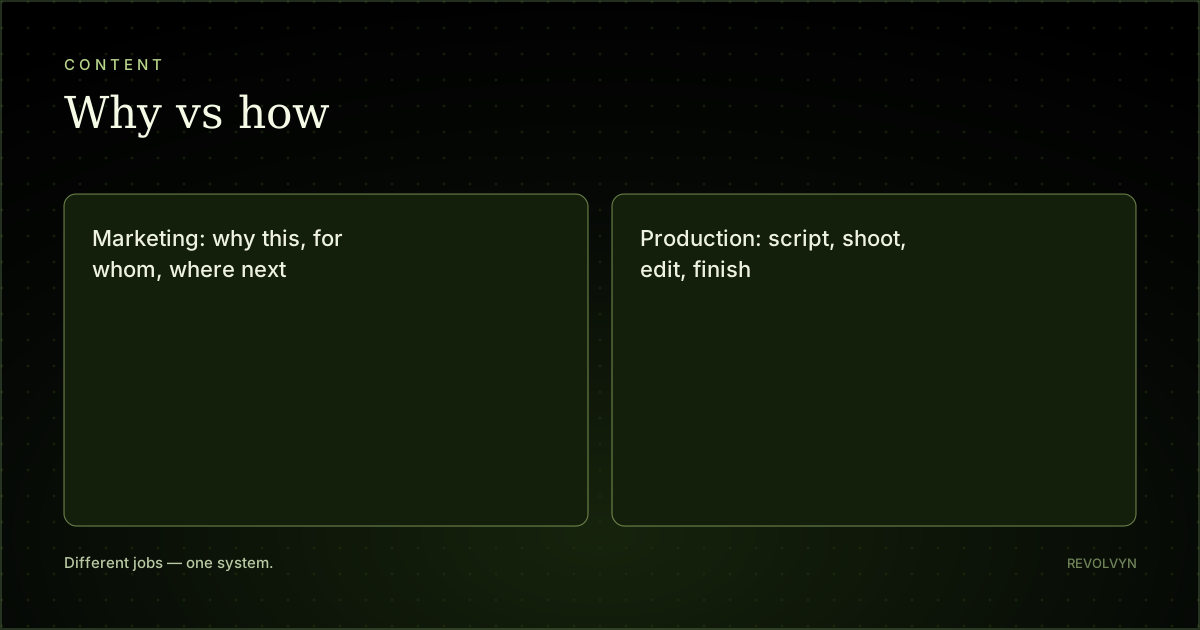
This is why content production and performance marketing increasingly overlap.
If the content team never sees performance feedback, they can keep producing the same style even when the market is asking for something else.
Build a library, not a single hero asset
For a growing D2C brand, the useful output of a shoot is often a library of material.
The brand can then create:
- multiple ad openings
- shorter cuts
- product demonstrations
- social posts
- retargeting variations
- landing-page media
The exact mix depends on the campaign.
The principle is simple:
Produce with reuse in mind.
That makes every shoot more valuable and gives the marketing team more creative options when performance data starts coming back.
Editorial note — This article is written for educational purposes and uses examples and capabilities documented on REVOLVYN's public website. Specific campaign outcomes, pricing and client-specific performance should be verified for the relevant engagement rather than assumed from general marketing guidance.
Related articles
Choosing what to do next?
Get a second opinion before you commit budget. Start with a free 15-minute consultation — no pricing games, no guaranteed miracles.
Contact REVOLVYN