SEO & Websites · 3 min read
Technical SEO Checklist for Business Websites
Crawl, index, canonicals, sitemap, titles, headings, mobile, internal links, measurement — the technical checks that actually matter.
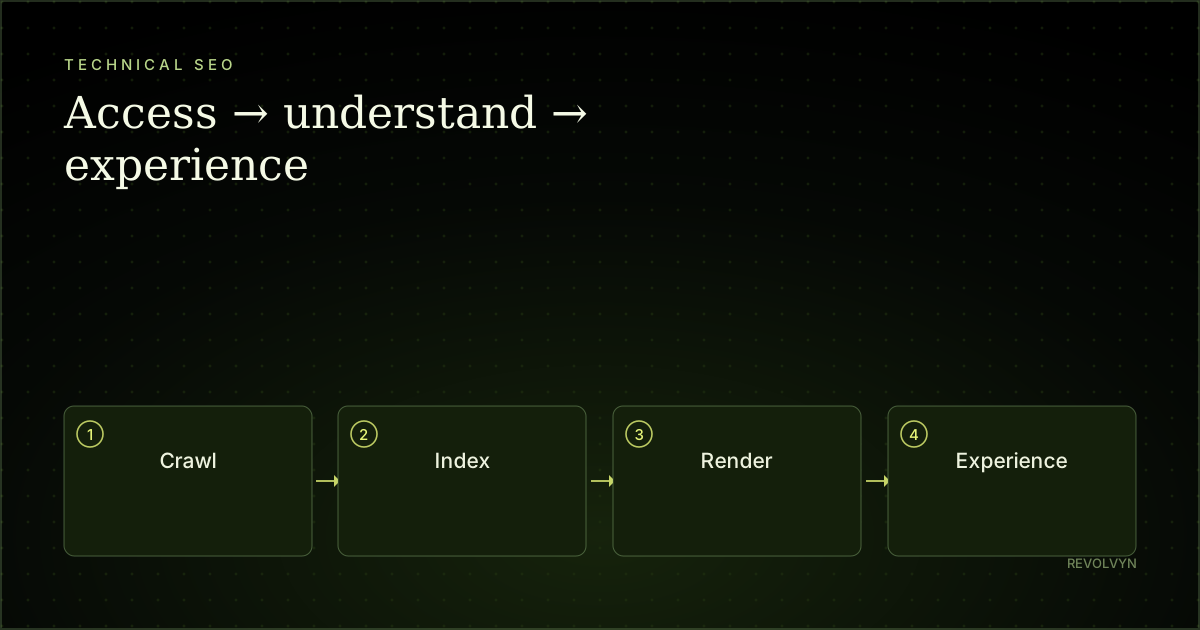
Technical SEO is often treated as a mysterious layer that only developers need to understand.
It is more practical than that.
The goal is to make sure search engines can access, understand and process the important parts of a website—and that users can actually use those pages.
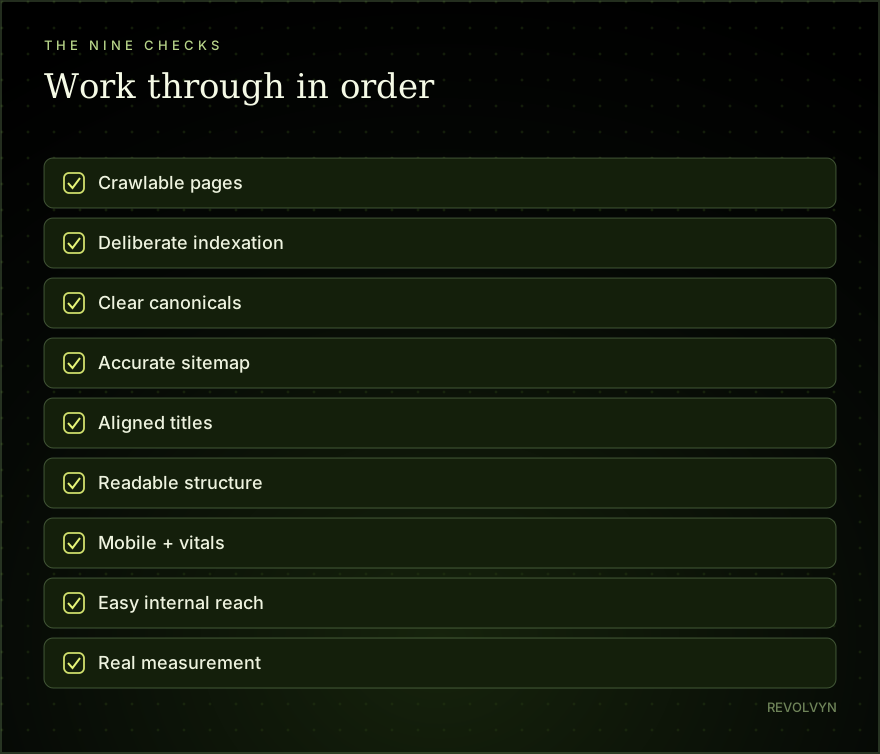
1. Can search engines crawl the important pages?
Start with the basics.
Chec
- robots.txt
- internal links
- crawlable navigation
- accidental blocks
- broken links
- redirect chains
- important pages with no incoming links
A beautiful page that cannot be discovered properly has a basic SEO problem.
2. Can the important pages be indexed?
Crawling and indexing are not the same thing.
A website should deliberately decide which pages belong in search.
Utility pages, admin interfaces, placeholders and duplicate variants may need different treatment from core commercial pages.
3. Are canonical URLs clear?
A page should have a clear preferred URL where appropriate.
Host variations, duplicate URLs and inconsistent canonical signals can make it harder for search engines to understand which version should represent the page.
4. Is the sitemap accurate?
A sitemap should represent the URLs that actually matter.
It should not become a dumping ground for every file on a website.
If a page is intentionally noindex, think carefully before listing it as a preferred indexable URL.
5. Do titles and descriptions match the page?
Titles help describe the page.
Meta descriptions can influence how a search result is presented, although they are not a simple ranking lever.
The important part is alignment.
A page promising “SEO services” should actually explain SEO services.
6. Is the content easy to understand?
Heading structure, readable paragraphs, useful links and descriptive image alternatives help both users and machines understand the page.
Structured data can also help Google understand supported content types, although adding schema does not guarantee a rich result. Google documents structured data as a way to provide explicit information about page content.
7. Does the page work well on mobile?
Responsive design matters.
So do Core Web Vitals and general page experience.
Google notes that its systems consider a range of page-experience signals and that good Core Web Vitals are recommended, while also stressing that good scores do not guarantee top rankings.
8. Can users reach the important pages easily?
Internal linking is often overlooked.
A service page should be connected from relevant parts of the site. Informational content should link naturally to deeper explanations or commercial pages where useful.
The goal is not to add links everywhere.
It is to make the next useful step obvious.
9. Measure the real site
Use Search Console and analytics where available.
Look for:
- indexing problems
- queries
- impressions
- clicks
- page performance
- Core Web Vitals
- crawl issues
Technical SEO is strongest when it is treated as an ongoing system rather than a one-time checklist.
Editorial note — This article is written for educational purposes and uses examples and capabilities documented on REVOLVYN's public website. Specific campaign outcomes, pricing and client-specific performance should be verified for the relevant engagement rather than assumed from general marketing guidance.
Related articles
Choosing what to do next?
Get a second opinion before you commit budget. Start with a free 15-minute consultation — no pricing games, no guaranteed miracles.
Contact REVOLVYN