Content, Social & AI · 3 min read
UGC Ads: Creator-Style Content for Performance
Creator-style content earns attention differently — but only when it opens with a real problem and tests different ideas, not 30 versions of one ad.
UGC has become a common advertising format, but the label can hide an important detail.
Not every creator-style video is automatically good advertising.
The useful question is whether the content communicates a relevant idea clearly enough for the intended audience to care.
What makes UGC useful?
Creator-style content can feel closer to the way people already consume social media.
Instead of a traditional product commercial, the viewer may see someone explaining a problem, demonstrating a product or sharing an experience.
That can make the creative easier to understand quickly.
But authenticity is not a substitute for strategy.
The video still needs a clear message.
What are UGC ads, exactly?
A UGC ad is a paid advertisement designed to look and feel like creator content. The brand usually plans it, pays for it and decides where it runs — the creator format is a delivery choice, not an accident.
That distinction matters. Organic UGC is content customers make on their own. A UGC ad is content made for a media budget. And both are different from whitelisting, where the ad runs through the creator's own account instead of the brand's.
The useful definition is functional: if a viewer could mistake it for a regular post, but a brand paid for its creation and distribution, it is a UGC ad. The job is the one you hire the creator to do — distribution, content ability, or both, as creator marketing vs influencer marketing explains. Our influencer marketing guide for brands covers how to structure that relationship.
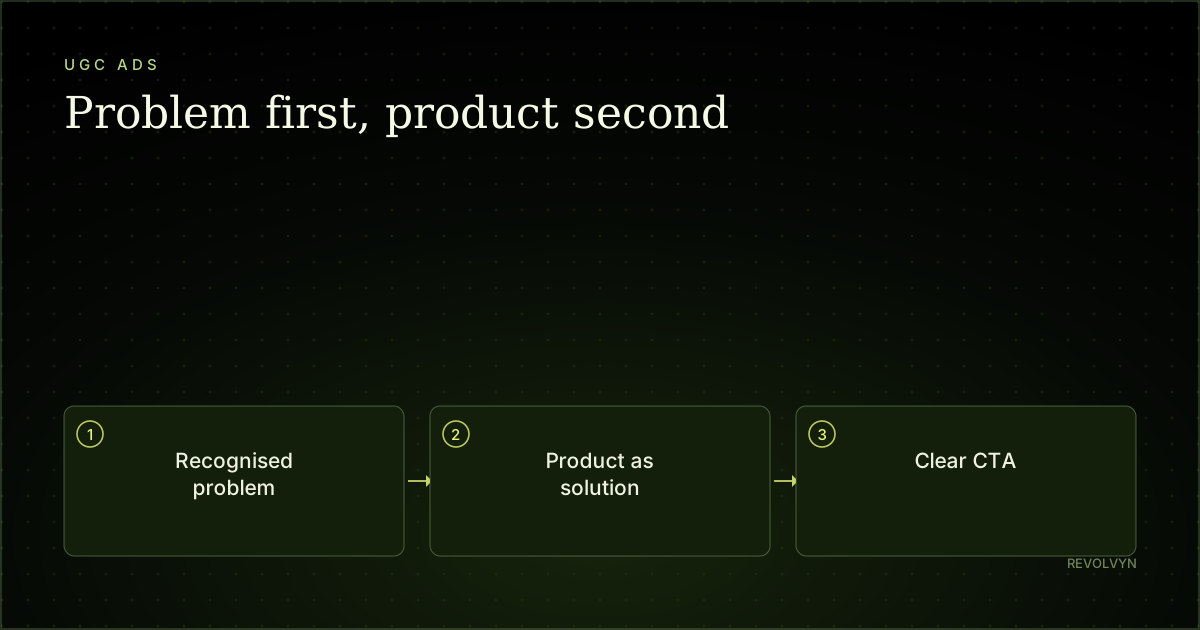
Start with the problem
A strong UGC concept often begins with something the audience already recognises.
For example:
“I kept doing X and couldn't figure out Y.”
That opening creates a reason to continue.
The product can then enter as part of the solution.
This is more useful than beginning with a list of product features that the audience has no reason to care about yet.
Six UGC ad types worth testing
Most performing UGC falls into a few repeatable types. Pick the type that fits the product, then vary the angle inside it — the video production guide shows how one shoot day can fill several of these at once.
Testimonial. A creator shares a specific experience with the product. Specificity is the difference between proof and noise.
Unboxing and first impression. The creator opens and reacts to the product. Best for physical products buyers want to inspect.
Problem–solution demo. Show the problem, then the product in use. A demo reduces uncertainty faster than claims do.
How-to and tutorial. Teach the outcome with the product as the tool. Works wherever the buyer needs confidence, not just desire.
Before–after. Frame the before-state in the viewer's own language, then show the after with honestly supportable proof.
Comparison and objection handling. Contrast with the old habit or competitor, or answer the top purchase objection directly. Our content production team builds these as repeatable formats, not one-offs.
UGC and polished production can coexist
Brands sometimes assume that choosing UGC means abandoning polished creative.
There is no reason to.
REVOLVYN's research notes as a working observation that UGC-style formats and polished brand films can earn attention differently, which is why both are worth testing.
A brand can use cinematic content to communicate product quality and creator-style content to test conversational angles.
The two formats can complement each other.
What should you test?
Try changing the communication idea rather than only the visual treatment.
Exam
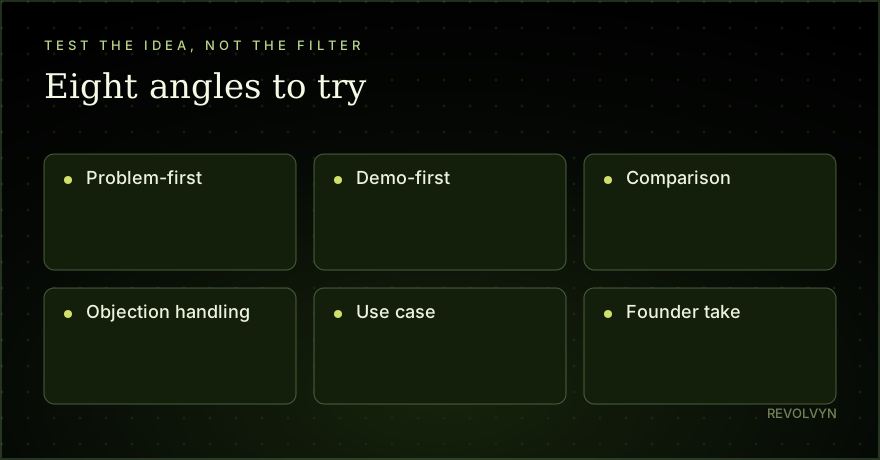
- problem-first
- demonstration-first
- comparison
- objection handling
- use case
- founder explanation
- creator recommendation
- before/after structure where the claim can be honestly supported
The best format depends on the product.
Three script frameworks that survive contact with the feed
A framework keeps every creative testing the same decision. Three cover most UGC briefs: hook–problem–solution–CTA, problem–agitate–solve, and promise–proof–push.
The hook carries the most weight. Name the viewer and the problem inside the opening seconds, and hold one idea per creative. A new hook on the same body is a new test; a new body on the same hook is a different one — track which you changed. Our Meta ads creative testing guide explains what to test before spend increases, and what performance marketing is explains the feedback loop these tests feed.
AI UGC is different from creator UGC
AI-generated content can increase creative production speed, but it should not be confused with a real creator relationship.
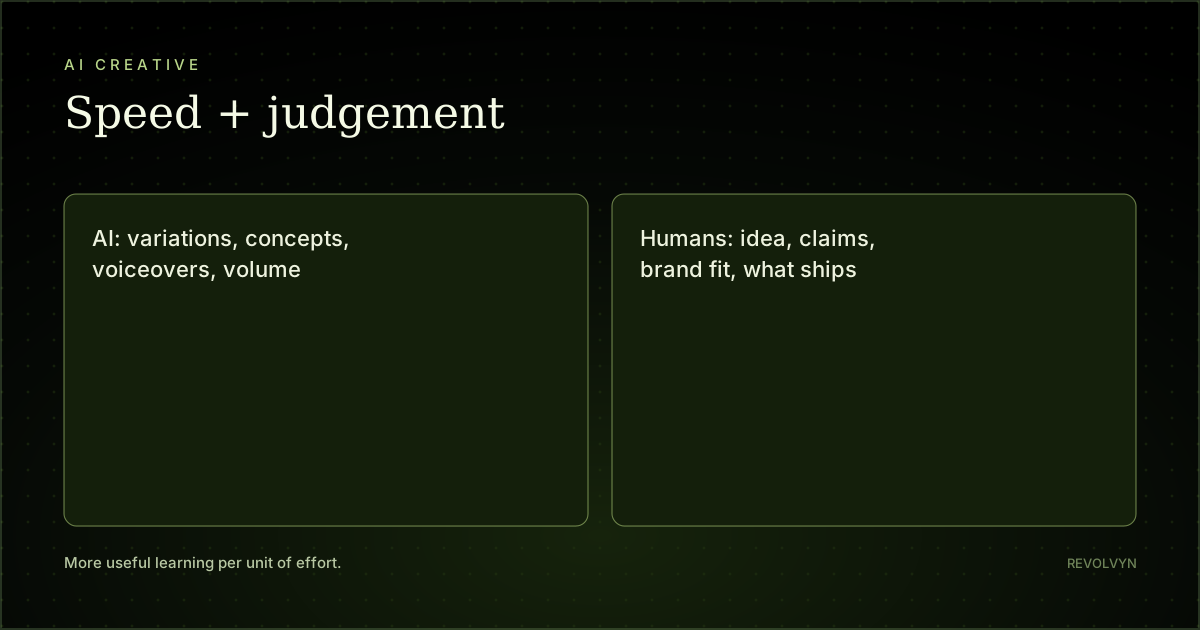
AI can help with product creatives, voiceovers, visual concepts and testing volume.
REVOLVYN's AI Content & Creative Automation service includes AI UGC videos, AI product creatives, brand-specific AI imagery and AI voiceover production.
The human role remains important: deciding the idea, checking the product truth, shaping the brand voice and deciding what is worth publishing.
The danger of making 30 versions of the same ad
More creative is useful only when the variations are meaningfully different.
If 30 videos say the same thing with the same opening, the brand may have created volume without creating learning.
A better system is:
one audience problem → several creative hypotheses → production → testing → learning → next brief
That creates a creative engine rather than a content pile.
UGC should still feel like the brand
“Native” does not mean careless.
The product should be shown accurately. Claims should be supportable. The CTA should be clear. The creator or generated voice should not make promises the brand cannot stand behind.
Good UGC feels natural to the platform while still being intentional about the business goal.
One export, five surfaces
Short-form runs on one shared spec: vertical 9:16 at 1080 × 1920 fills TikTok, Reels, Shorts, Stories and Facebook Reels. Shoot and edit for that frame first.
Then adapt, because surfaces differ. Meta feeds reward 4:5 or 1:1 for scroll real estate. TikTok in-feed ads cap at 60 seconds. YouTube Shorts run up to 3 minutes. Every platform overlays its own interface — right-side action rails, bottom captions, channel rows — so keep faces, product and on-screen text inside the centre and clear of the edges. Export MP4 (H.264); platforms compress on ingest, so upload the highest quality you have.
Organic and paid cuts can share footage but need different edits — our social media management guide covers the organic side, and performance marketing covers the paid testing cadence.
Disclosure: the part brands skip
A paid creator post is an endorsement, and endorsements carry disclosure duties on both sides of the deal. In the US, the FTC's Endorsement Guides require any material connection — payment, free products, employment, even family ties — to be disclosed in a way that is difficult to miss and easy to understand. For video, that means inside the video itself, in audio and/or on screen, in plain words such as “ad” or “sponsored” — a description-box note alone is not enough, and a platform's branded-content toggle alone should not be relied on. Brands are expected to brief creators on this and monitor what goes out under their name.
In India, ASCI's influencer guidelines set the same direction with precise video rules: an upfront, prominent label (Ad, Sponsored, Collaboration, Partnership and the other permitted labels), shown for at least 3 seconds on videos up to 15 seconds, for at least a third of videos between 15 seconds and 2 minutes, and for the full brand-mention section on longer videos. Responsibility sits with both advertiser and influencer, and product claims must be supportable — which is why briefs should lock claims before the shoot, as our influencer marketing guide recommends. Creator sourcing and coordination is also part of our influencer marketing service.
Editorial note — This article is written for educational purposes and uses examples and capabilities documented on REVOLVYN's public website. Specific campaign outcomes, pricing and client-specific performance should be verified for the relevant engagement rather than assumed from general marketing guidance.
UGC ads: quick answers
What are UGC ads?
Paid advertisements designed to look like creator content. A brand plans, pays for and distributes them — which separates them from organic customer posts. See creator marketing vs influencer marketing for the roles creators can play.
How is creator UGC different from AI UGC?
Creator UGC buys a real human relationship and native delivery; AI UGC buys testing volume and speed. The strongest setup uses AI for variations and human direction for the idea and claims. See AI UGC and AI product creatives.
Do UGC ads need disclosure labels?
Yes, whenever a material connection exists between brand and creator. The FTC requires clear, in-video disclosure; ASCI requires upfront prominent labels with duration rules for video. Brief this in writing before the shoot.
How long should a UGC ad be?
Match the surface: short-form native, with the hook in the opening seconds. TikTok in-feed ads cap at 60 seconds; YouTube Shorts run up to 3 minutes. Test length as a variable, not an afterthought.
Where should a brand start with UGC ads?
Pick one audience problem, brief three different angles on it, and keep the landing page message continuous — see landing pages for paid campaigns. Then bring a product and a hypothesis to a free consultation.
Related articles
Need help connecting paid media, creative and conversion?
Talk to the REVOLVYN team. Start with a free 15-minute consultation — bring a product and a hypothesis, we’ll bring the creative engine.
Contact REVOLVYN