Content, Social & AI · 3 min read
Social Media Management for Growing Brands
Consistency is table stakes. Good management means repeatable themes, trend judgment, community, and reporting that changes next month’s plan.
Social media management is often reduced to “posting consistently.”
Consistency matters. It is not the whole job.
For a growing brand, social should have a reason to exist beyond filling a calendar.
Start with the role of each platform
Different platforms encourage different behaviour.
A brand might use short-form video for discovery, carousels for education, stories for ongoing interaction and other formats for deeper communication.
The exact mix should follow the audience and the brand's content strengths.
REVOLVYN's social media service covers strategy, content planning, Reels, carousels, Stories, copywriting, trend research, competitor analysis, community management, performance analysis and monthly reporting.
Build content around repeatable themes
A useful social system usually has recurring themes.
For
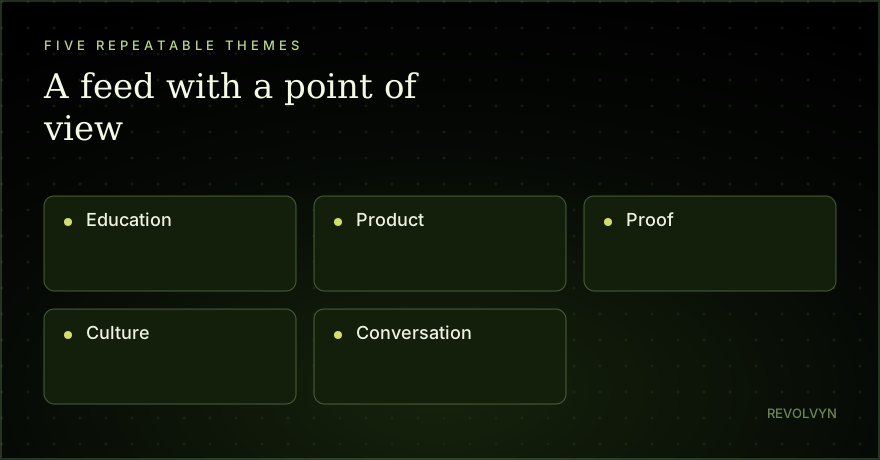
Education — help the audience understand the category.
Product — demonstrate what the product does.
Proof — show work, use cases or customer-relevant evidence.
Culture — show the people and ideas behind the brand.
Conversation — create reasons for people to respond.
The exact categories should fit the brand.
Trends are not a strategy
A trend can help distribution.
It cannot replace a clear point of view.
If a brand jumps on every trend without understanding why it fits, the feed becomes inconsistent and the audience learns very little about the product.
Trend research is useful when it helps a brand communicate its existing idea in a more native format.
Social and paid media should learn from each other
A strong organic post can reveal an interesting hook.
A paid campaign can reveal which product message deserves more attention.
These insights can flow in both directions.
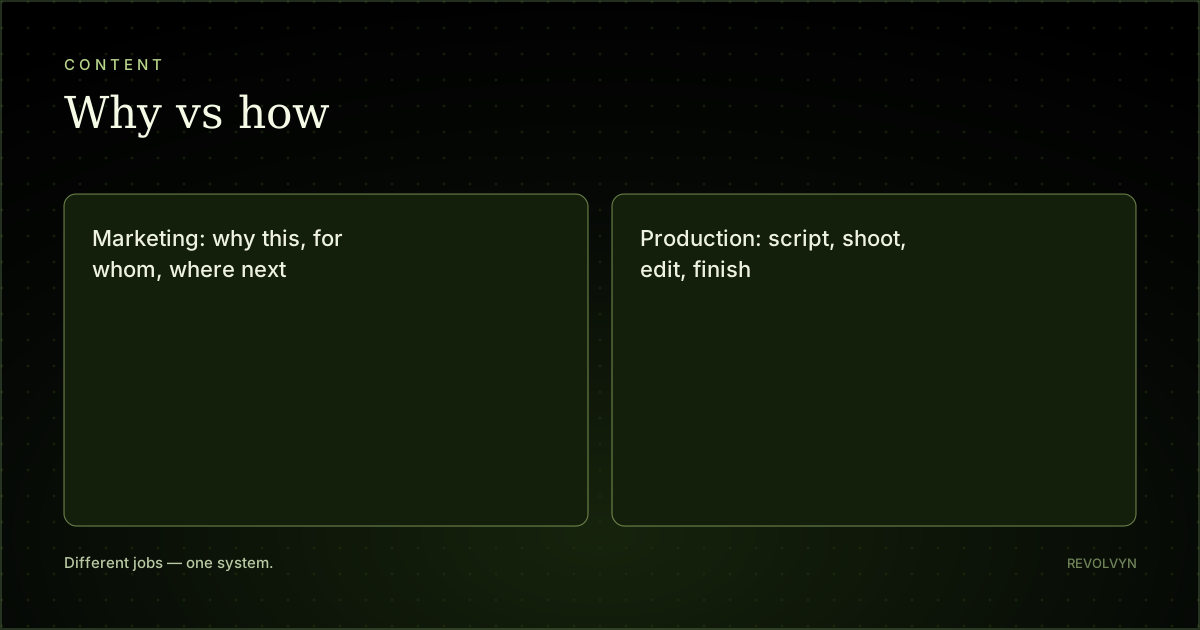
That is one reason social media should not operate as a completely separate department from performance marketing and content production.
What should monthly reporting answer?
A report should help the team decide what to do next.
Instead of only listing reach and impressions, ask:
- Which content themes earned attention?
- Which formats generated useful engagement?
- Which messages should be repeated?
- What did the audience ignore?
- What should change next month?
The purpose of reporting is not to make a spreadsheet look busy.
It is to improve the next content plan.
A practical social workflow
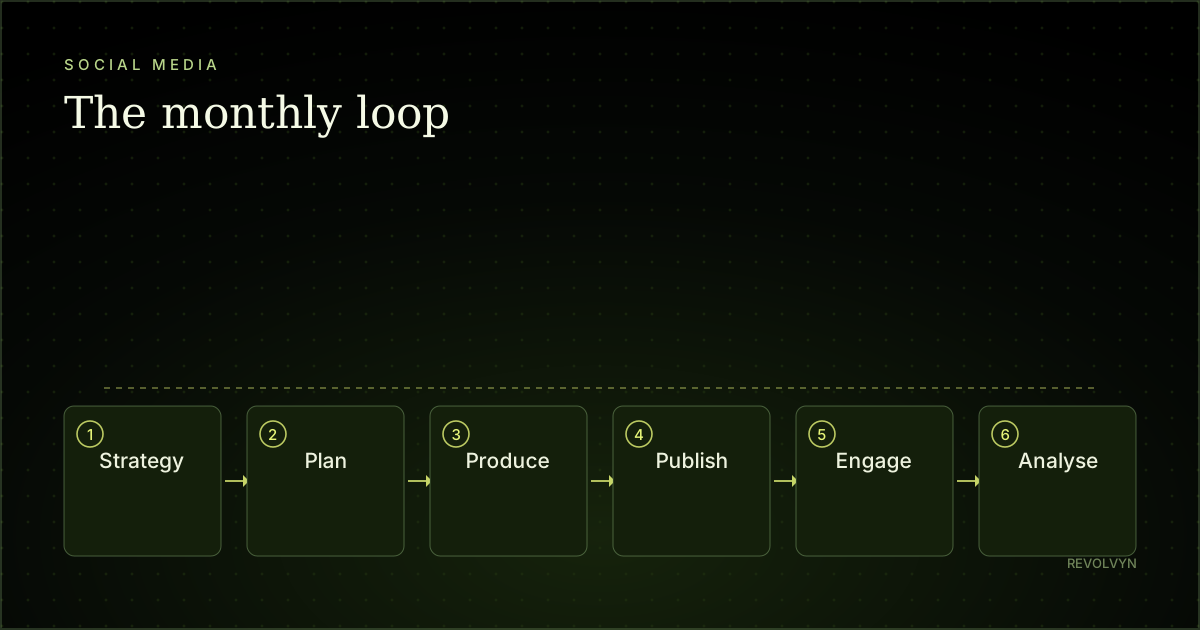
A simple cycle looks like:
strategy → planning → production → publishing → community → analysis → next plan
The loop repeats.
Good social media management makes that loop easier to operate consistently while keeping the content connected to the broader marketing objective.
Editorial note — This article is written for educational purposes and uses examples and capabilities documented on REVOLVYN's public website. Specific campaign outcomes, pricing and client-specific performance should be verified for the relevant engagement rather than assumed from general marketing guidance.
Related articles
Talk to REVOLVYN about your growth plan.
Have a campaign in mind? Start with a free 15-minute consultation and we’ll reply within one business day.
Contact REVOLVYN